Consensus Beyond Beauty: The Goal of UX Design
UX design is not an artist's subjective expression, but a logical problem-solving process that architects optimal experiences through rigorous user analysis. By providing objective evidence based on fundamental, environmental, and personal contexts, we can achieve constructive consensus beyond mere beauty among stakeholders.
2026.04.13
UX design is not art. However, this does not mean it is a field devoid of creativity. On the contrary, the higher the level of expertise you attain, the more moments you face where you must explore the unknown and exercise your creativity. This is also why pioneers around the world today are driving countless innovations in the form of businesses.
The reason I firmly state that UX design is not art is that design is not a medium for freely expressing the creator's personal desires. While intentions can sometimes be strategically concealed, an interface can never be considered successful if it leaves room for divergent interpretations among users. The priority is to define a clear target audience and apply clear, intuitive symbols and narratives tailored to their level of understanding.
In this sense, 'consensus' among project stakeholders is absolutely crucial in UX design. To maintain constructive dialogue and avoid unnecessary emotional drain, we need our own decision-making framework. I have categorized the ways users interpret and respond to external stimuli into three fundamental frameworks:
1. The Fundamental Aspect This refers to the common denominators shared by all human beings. Ergonomic categories such as gender differences, universal psychological mechanisms, physical limitations, and range of motion fall into this aspect.
2. The Environmental Aspect This refers to the culture to which the user belongs. Humans are beings whose decision-making criteria constantly evolve through interaction. This includes factors such as family environment, economic situation, historical background, physical space, and range of daily activities.
3. The Personal Aspect This refers to the unique tendencies and preferences of each individual. It can be viewed as a complex amalgamation of the aforementioned 'fundamental' and 'environmental' factors. While personal tastes can be highly visible, they are also often hidden deep within, requiring a thoughtful process of cultivation and discovery.
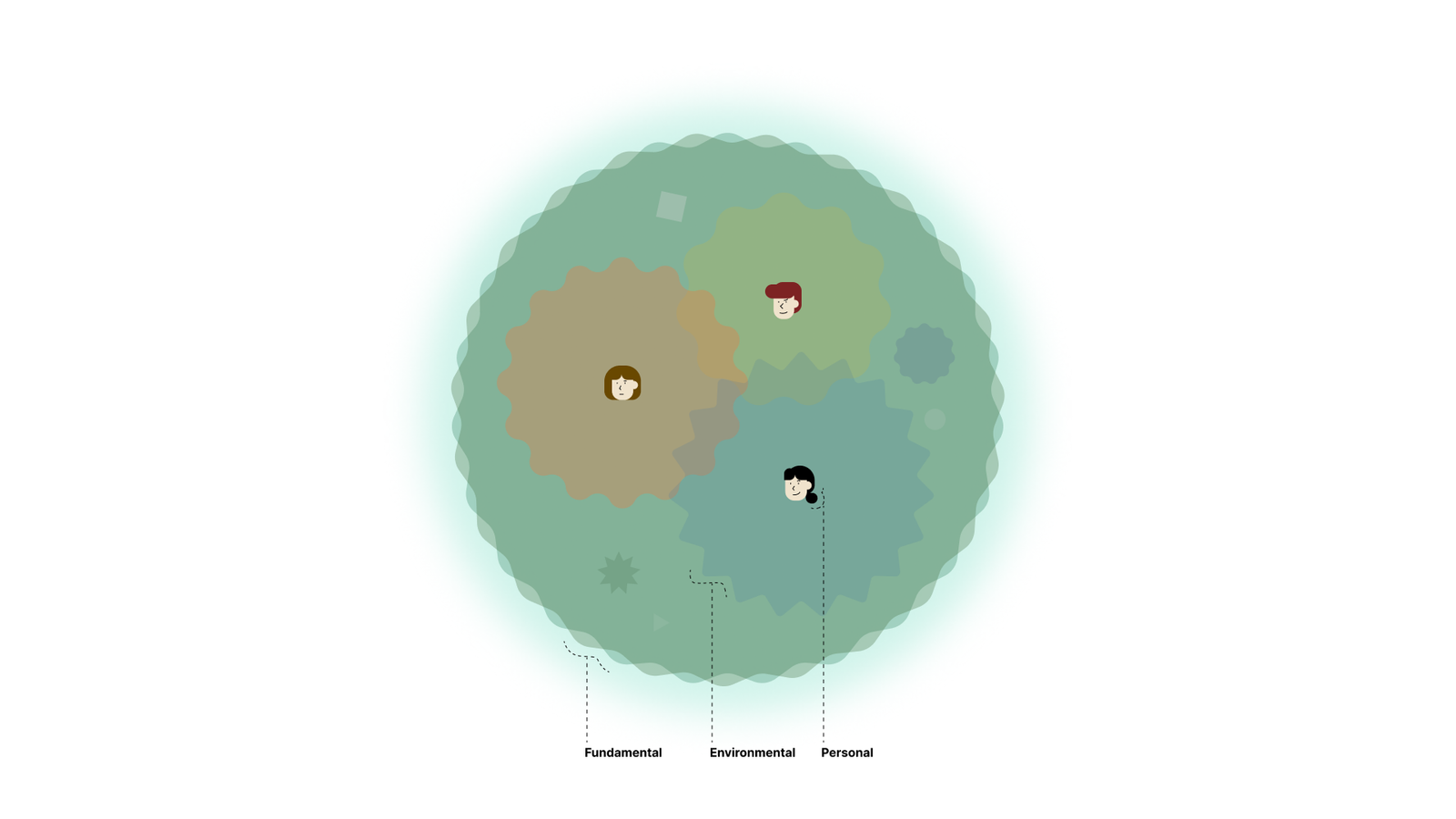
<Diagram of the 3 Frameworks>
These three frameworks are mutually independent yet closely interdependent, ultimately coming together to form a single cohesive user experience.
Ultimately, these frameworks serve as more than just a tool for analyzing users; they become a 'common language' for communicating with project stakeholders. Constructive consensus is only achieved when we move beyond subjective impressions like "This design looks prettier" and instead present objective evidence, stating, "This design is logically sound within its fundamental, environmental, and personal contexts."
Elevating design into the realm of logic, and thereby discovering clear solutions amidst complex business interests, is the true role of a UX designer. Ultimately, UX design goes beyond subjective creation; it is a 'problem-solving process' that architects the optimal experience through rigorous analysis and strategy.