A Bottom-Up Model of the Human Mind: The Components of a Person
How does a fleeting whiff of coffee lead to an action that proves my 'personhood'? A step-by-step narrative that begins with sensation and cognition, navigates through instinct and reason, and ultimately culminates in 'character'.
2026.04.17
Imagine catching the scent of coffee from a cafe you happen to pass by on your morning commute. At first, it is merely a simple smell brushing past your nose. However, you soon recall your favorite local cafe, crave caffeine, and feel a sense of comfort from the thought of a cup of coffee. After calculating your remaining commute time and budget, you end up buying two cups and placing one on a tired colleague's desk.
This everyday, fleeting process is a microcosm of how a simple physical stimulus leads to a completed, personal action. From the moment external stimuli flow inward to their integration into a unique self, the human mind possesses a multi-layered, systematic structure that deepens from the bottom up.
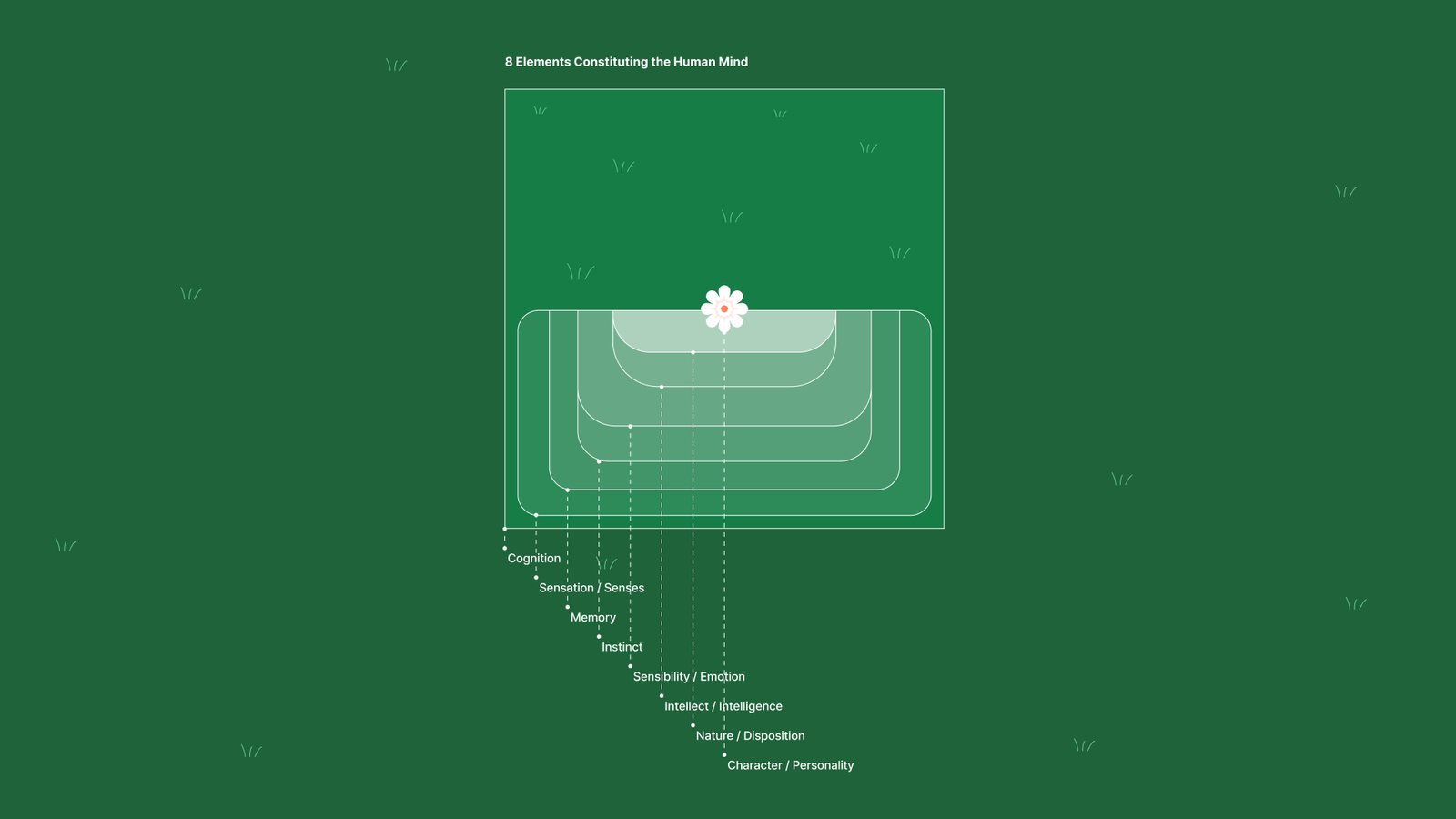
1. The Interface with the Outside World: Cognition and Sensation Cognition and sensation lie at the first stage of the encounter between humans and the world. In psychology, the process of primitive stimuli—like light, sound, and smell—being transmitted to the brain through sensory organs is called 'bottom-up processing.' These raw inputs are then interpreted and given form through 'top-down processing,' where the brain uses existing knowledge and context to complete a clear perception. This stage is the most intuitive and superficial system, designed to accept objects as they are and pass them on to the next process of internalization.
2. The Foundation of the Inner Self: Memory and Instinct Information that passes through the surface is incorporated into an individual's history and combined with biological temperament. Neuroscientist Eric Kandel's research proved that 'memory' is not just abstract information but a physical change that strengthens synaptic connections. Fragmented sensations are embodied in the brain, acquiring the continuity of experience. These accumulated memories combine with what Sigmund Freud termed the 'Id'—the unconscious, blind instinct driven toward survival and pleasure. This intermediate layer becomes the practical foundation that drives our actions without conscious effort.
3. The Judgment of Meaning: Sensibility and Intellect Higher-dimensional judgment begins on the firm foundation of memory and instinct. In this layer, humans activate sensibility to feel situations emotionally and intellect to deduce cause and effect logically. Daniel Kahneman's 'Dual Process Theory' clearly explains this stage. 'System 1' (sensibility), which is fast, intuitive, and emotionally driven, constantly interacts with 'System 2' (intellect), which is slow, analytical, and logical, to make decisions. When these two systems intersect organically rather than exclusively, objective reasoning about the utility and value of life—beyond mere survival—becomes possible.
4. The Texture of the Inner Self: Character Located in the deepest realm, character is the solid inner texture accumulated through the long-term interaction of the preceding layers. According to C. R. Cloninger's 'Temperament and Character Inventory (TCI)' theory, unlike 'temperament' (instinct), which is a genetically innate automatic response, 'character' is a domain refined a posteriori through individual will and social experience.
This aligns with Aristotle's view of 'Virtue (Eudaimonia)', the highest state where intellect and emotion are tuned by reason and finally solidified into habit. This firm shape of the ego, forged as sensed and perceived information struggles or compromises with instinct, is not easily shaken by fleeting emotions or external conditions.

Conclusion: The Integration of Character and the Completed 'Personhood’ If character represents the solid bricks forged within over a long time, 'personhood' is the completed architecture built with those bricks. This bottom-up model demonstrates the path through which simple external information passes through sensation and cognition, penetrates the base of instinct, is tuned by sensibility and intellect, and is cultivated into a solid 'character,' finally completing itself as a holistic and independent 'personhood' standing before others and the world.
This is the state of 'Self-actualization' located at the very apex of Abraham Maslow's hierarchy of needs, and the deepest proof of existence a human being can reach. To fully understand a person is, ultimately, to look at a massive, completed architecture that penetrates all these layers.